Sedbergh’s rich archive collection is the result of generous donations over many generations. It is a great privilege to have so many primary source documents to bring Sedbergh’s past to life. Amongst this collection are eleven boxes of ‘magic lantern slides’, glass positive slides from the 19th century and early 20th century which offer rare insight into life at School up to 150 years ago.
In Spring 2025 the Development Office purchased a new high resolution archive scanner and transparency unit to help bring the collection of photographs and glass slides to life in Sedbergh’s 500th year. Over the course of Sedbergh’s quincentenary year this special collection of images will be digitised and shared, offering a unique view to our past.
As the images are captured between two pieces of glass, held together by tape, it is not possible to capture the picture using a conventional scanner. The new transparency unit allows us to capture the image without causing blurring as the light refracts through the glass.
It is most exciting to have the opportunity to scan and share these images, some over 150 years old. The images include early Wilson Run races, scenes in boarding houses, portraits of staff and views of the School site. The informal nature of the scenes make the images most engaging, and very different to most of the posed shots in the collection from that time.
We look forward to sharing the collection of magic lantern slides as they are scanned.
Katy de la RivièreSchool Archivist This year the OS Club will be live streaming the Wilson Run from the fells, as well as at the start and finish. We invite you to join us from 1.30pm GMT on Tuesday 25th March 2025 for the pre-show using the link below. The race will start at 2.30pm.
Wilson Run 2025 | Live Stream
Coverage includes pre-race interviews with record holders, runners, and the School Archivist. The race will follow the runners around the course with commentary by Ben Collins (Associate Director of Development and Wilson Run winner) and Jan van der Velde (Director of Development).
The weather is wet, the rivers are swollen, the fells boggy under foot. Never was ‘strain and struggle, might and main’ so apt. It all makes for an exciting day. Do join us at 1.30pm on Tuesday 25th March.
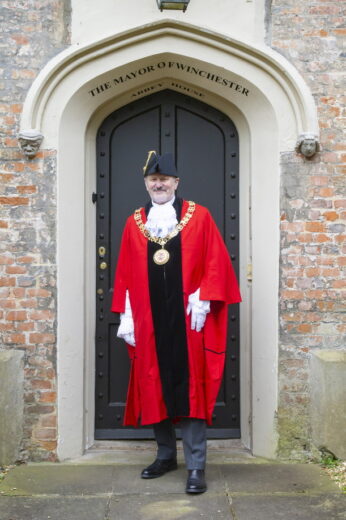
We look forward to you joining us over the Wilson Run period!There has been a mayor of Winchester since 1199, the year that Richard, Coeur de Lion, died and his brother, King John, succeeded to the throne of England. The city is proud to say that the mayoralty of Winchester is second only to London in seniority. Over the centuries the power of the mayor has changed from being the leader of an influential oligarchy to being rather more a figurehead representing the City of Winchester and the district which covers 250 square miles.
Whilst the mayor no longer has executive powers, he or she has a number of important statutory duties: leading civic events, granting freedom of the city, wreath-laying, chairing the monthly meeting of the full council. There are some light-hearted occasions too: the annual Shrove Tuesday pancake race held in the Cathedral close and leading the procession to the November 5th bonfire night display and setting off the fireworks.An important element of the role is recognising the work of charities and encouraging volunteer efforts, particularly those of smaller and lesser known specialist local charities that do such sterling work. As I spend a lot of my time visiting local businesses and charities, I can foster and encourage useful links between them.Every mayor each year selects three or four local charities to promote. I have chosen four. Fundraising is time consuming and by no means easy in our present financial climate. I have been immensely grateful to all the volunteers who have worked so hard with me to raise money for the chosen charities. I have brought in some innovative ideas such as special mayoral merchandise to sell at a range of money-raising events throughout the year.
A sound economy is essential to the district, and I am always keen to support new businesses that open up or expand in the area. Recently I went to an event to celebrate the expansion of the Saab Business Campus. I have opened many new shops, cafes, restaurants and even a funeral service. I had to think hard about what to say in my speech wishing their business success.
By tradition, the mayor, during the year of office, becomes a trustee of various organisations. One of my favourites is the Hospital of St Cross, the most ancient alms-houses in the country. ‘The Brothers of Noble Poverty’ are a lovely group, and amongst them is David Kilmister, an Old Sedbergian, (Hart), who recognised my OS tie which I happened to be wearing when I first visited. The mayoralty also has strong connections with the Cathedral and its ancient Christian traditions. We hold an annual Mayors’ Sunday in which the Mayor of Winchester sets the theme for the service.
I have learned so much during my time as mayor: many aspects of our ancient city and the wonderful people who live within and throughout the district. I have found that one sees the very best side of citizens, and people really appreciate a visit by the mayor, particularly when he or she turns up wearing the wonderful gold chain and full regalia. My best memory of this is of my visit to a special needs school. The Head had asked that I come in ‘full fig’ as the children love to see it. One little boy stopped in his tracks and said, ‘Are you the King?’ It made my day.
Russell Gordon-Smith
Read a Winchester City Council article about Russell HERE.
On Monday, 3rd February 2025, Sedbergh School launched its 500th anniversary celebrations with a magnificent concert at the Bridgewater Hall in Manchester. This unforgettable evening marked the start of a historic year of commemorative events, bringing together the entire Sedbergh community in a shared celebration of our rich heritage.
Please click here to read the full review on the School website and view the photo gallery and video of the concert.
We are extremely grateful to Peter Weeks (Powell 64-68) for his report regarding Robert Digby-Jones, who was awarded the VC after the Boer War. Peter recently visited the grave of Digby-Jones in South Africa. He writes:
We are all familiar with the monument above the Cloisters commemorating the 3 OS who won the VC in World War Two. Less well known is Sedbergh’s fourth and earlier VC, awarded posthumously for an action that took place in the Siege of Ladysmith during the Boer War. On a visit to Ladysmith a few years ago I found the grave of Robert James Thomas Digby-Jones. This is his story.
Robert Digby-Jones was born in Edinburgh in 1876 and educated at Alnouth, Northumberland and at Sedbergh. He entered the RMA Woolwich in 1894 and was commissioned 2 years later into the Royal Engineers. 1899 found him in 23 Field Coy, RE, in the small town of Ladysmith in Natal, South Africa at the start of the Boer War. The town was soon surrounded and besieged by a Boer army which overlooked the town from a ring of low flat-topped hills. Wagon Hill lies to the south just within the British lines. During the night of 5th January 1900 a party of gunners and sappers including Lieutenant Digby-Jones were installing a naval gun on the south-west point of Wagon Hill when out of the darkness Boers from the Free State made a surprise attack. Fierce fighting continued into the morning all along Wagon Hill – a critical point for the town’s defence – before dying away. Around one o’clock a party of Boers again stormed over the edge of the crest, this time reaching right up to the gun emplacement. Digby-Jones shot one of the Boer leaders, De Villiers, at close range with his revolver and led the fight to clear the hilltop, losing his life in the mêlée.
Digby-Jones lies in Ladysmith cemetery. Near the site of the gun emplacement on Wagon Hill are memorials to him and to De Villiers.
An interesting footnote. The award of posthumous VCs was sanctioned by King Edward VII in 1902 after the end of the Boer War with the family of Digby-Jones receiving his medal. Formerly the VC was only awarded to living recipients.
Brass tablets were put up in St Mary’s Cathedral and Alnouth parish church to his memory and a red sandstone memorial stands in the grounds of the School Chapel behind Malim Lodge.
Peter Weeks
OS, P (1964 – 1968)I’m not sure if you have ever had the chance to visit the New Club on Princes Street, how would I know after all. On the assumption that you haven’t been there, let me tell you that the Club is not new, neither is it easy to locate.
If you are lucky enough to be invited you will find it on Princes Street in Edinburgh behind the most unassuming of grey doors which normally would be taken for an entrance to an NCP car park or the type of door on the Underground that has ‘Authorised Personnel Only’ written on it. Many times have we received desperate last minute phone calls over the years asking where the New Club is by those in need of a prosecco.
And so this November we once again hosted the Edinburgh Lunch for forty of the finest people you can find in that glorious city. What I really enjoyed, and there was much to commend, was the mix of ages. We need youth as well as experience, and we had both. On a personal level I was delighted to meet people whom I haven’t seen since my school days. The warmth of human fellowship was abundant, and the general crescendo of chatter in the dining room filled our ears, telling Ben Collins and I that such events are so worthwhile to hold, and to attend.
The Headmaster, Dan Harrison, spoke about the success of the School and his optimism for the future. He was animated, his banners unfurled, his colours nailed to the mast, and whatever other idiom one might care to use to express the Shakespearean ‘Henry V at Agincourt’ that stood before us. It went down very well.
Our thanks to the New Club and in particular to Neil McKerrow for acting as our host member. And thank you to all those who joined us. We did very much enjoy your company.
Jan van der Velde
Lupton House 1977-1982
Director of DevelopmentMembers of our Community may have seen the news that a major fire has damaged the centre of Kirkby Lonsdale. Tragically one man died in the blaze. We offer our sincere condolences to the family.
The fire could not have come at a worse time for traders in this historic market town. Our thoughts are with those who have been affected. Here is the Fundraiser page for those who may wish to offer support.
I would like to highlight one in our community, an Old Sedberghian Josh Redmayne (H) who left School in 2017 to study jewellery in Birmingham’s Jewellery Quarter. In March 2024 Josh opened the doors of J.T.R. Jewellery in Kirkby Lonsdale. Now, after a successful launch and a good summer, his busy Christmas period had ground to an abrupt halt as the High Street closed whilst emergency services dealt with the situation.
He is a young entrepreneur, just setting out on his commercial journey. He will be helping out where he can in the town and, for the foreseeable future, will be donating 10% of sales for all nature pieces and bestsellers to help support those affected.
He hasn’t asked us to promote his business, as he is concerned more about the town than himself, but I know some may want to know more, and you can find the link to his business at www.jtrjewellery.co.uk or his Instagram page @j.t.r.jewellery.
Please note that there is also a Late Night Shopping event at junction 36 (Crooklands) on Wednesday 18th December to support all the businesses in Kirkby Lonsdale.
As I say, our thoughts are with those in Kirkby Lonsdale. We wish them well and hope that the scars heal soon.
Jan van der VeldeSir Alastair Cook feels Harry Brook can challenge Joe Root’s England records; Brook has seven tons in 22 Tests and averages over 60, with Sky Sports’ Ian Ward saying: “His ability is staggering and it is the manner with which he can put pressure back on bowlers and go through the gears”.
Read full article HERE.Renovations are always an exciting prospect in the world of conservation. Peeling off layers of paint, or plasterboard, dismantling furniture or taking apart artefacts can lead to a greater understanding of an item’s provenance or history. The process of uncovering untold stories can be a rich and enlightening experience.
This summer experts from Cumbria Stained Glass, Peter and Charlotte, spent several months working methodically to renovate the 19th century windows on the School Library. The hand-blown panes are held in place by bands of lead in a 3 x 5 quarries pattern, apart from one rogue 3 x 4 panel in the southeastern most window. These panels are held in place in softwood frames that have suffered from the prevailing south westerly winds. Any conservation work on these iconic windows needed to be sympathetic to the original Grade II listed building with new elements matching the originals as closely as possible.
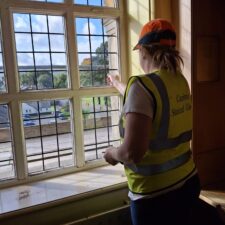
A joinery created new sections of frame to replace damaged originals. Peter and Charlotte painstakingly cleaned every pane of glass, carefully teasing out those panes that were being replaced, or migrated to new and sturdier frames. While cleaning a tiny pane of glass on the top floor, Charlotte was delighted to find a date and initials scored into the glass by a young graffiti artist. When looking through a tiny pane against the afternoon sunlight she spotted ‘AL 1922’ in the top corner of the glass. Having checked in the School archive it was found that there was only one boy in School with those initials in 1922.
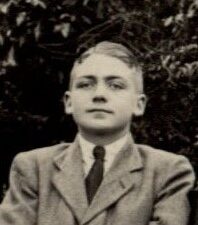
Alec Laurie
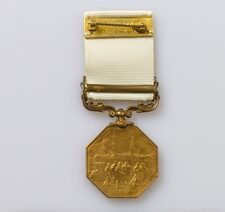
Polar Medal
Charlotte from Cumbria Stained Glass
Alec Hibburd Laurie, who hailed from Edinburgh, was a pupil in Evans House from 1920 to 1925. Despite his penchant for graffiti, he was a house prefect in his final year at School. He was the Bernard Wilson Scholarship recipient throughout his time at Sedbergh, so it is fitting that his chosen location for graffiti is now used as the scholars’ room in the top floor of the library. Academic endeavour was clearly important to him as he went on to study at King’s College, Cambridge before becoming Assistant Biology Master at Westminster School. His teaching career was fairly short as Alec soon joined the crew of the R. R. S. Discovery serving as a biologist and chemist. He served at the Discovery Investigations marine laboratory, South Georgia, in the 1930’s and on a whale marking cruise. He was well regarded in the field of marine biology for his research into reproduction of blue whales, and the physiology and structure of whale respiratory mechanisms. He was awarded the Polar Medal in 1941. During the Second World War he worked for Naval Intelligence and was involved in researching weapons. On returning to civilian life after the war Alec applied his scientific methodology to finding practical solutions for real world marine issues, such as harbour protection, fish farming and sewage treatment. He died in 1987 having made a tremendous contribution to the study of marine chemical and biology.
While we won’t be encouraging pupils who currently occupy the scholars booths to graffiti the windows, we’re delighted to have the example of Alec to share with them. A young man who clearly left his mark on the world, in more ways than one.
Katy de la Rivière
Archivist
Sedbergh Staff 1981 – 2010
Sedbergh School is saddened to share news of the death of Hugh Symonds on Monday 25th November 2024, aged 71 years. Hugh was a very much loved mathematics teacher, including a decade as Head of the mathematics department; he served as a tutor in Evans House for 24 years; was elected chairman of the Common Room by his peers and held roles as master in charge of running, the Wilson Run, athletics and careers during his 29 year career at Sedbergh. Following Hugh’s retirement, the Sedberghian magazine recorded that ‘his service at Sedbergh was distinguished by his modesty and genuine kindness.’
Hugh arrived at Sedbergh in 1981 to take up a post in the Mathematics department. Taking over responsibility for School running at the end of his first year in Sedbergh, Hugh was a wildly inspirational running master. He devised challenges that inspired pupils with varying experience of running to engage with the sport for the first time, and led those elite athletes in the School to become some of the greatest schoolboy and -girl runners in the country.
One such example was the 1988 Charity Run which involved over 400 participants, running in relays to cover the eighty miles from Sedbergh to Martin House Hospice, Wetherby, in ten hours. The event raised over £10,000 for the hospice. Hugh ran the entire distance himself. ‘Help from the Howgills’ raised £10,000 for Intermediate Technology in two weeks of the Summer Term in 1989. The challenge presented to each participant was to climb all thirty-one summits in the Howgills that are over 1,500 feet within the fortnight. Sponsorship was per peak. The response was excellent and many pupils attempted all thirty-one peaks.
Hugh also undertook personal challenges that made a tremendous impression on pupils and colleagues alike. Hugh took the summer term of 1990 as a sabbatical and supported by his wife Pauline and their children Andrew, Joseph and Amy, he made the first continuous traverse of all 296 peaks over 3,000 feet in Scotland, England and Wales before, with time to spare, he crossed to Ireland and scaled seven more such summits. By doing so, he raised some £25,000 for Intermediate Technology, a charity in which he took a close interest.
He took charge of the organisation of the Wilson Run in succession to Roger Moore in 1995. During 2004 to 2010 the Wilson Run course was extended by 300 yards when a landowner rescinded access to his land creating the need for an enforced diversion at Cautley. In his final year in post Hugh’s skilful and sympathetic negotiation led to the resumption of the race’s original course, including the crossing of a key field. Hugh was concerned that a significant number of runners had inadequate training for the race. This led to the introduction of qualifying times for prospective competitors in 2006. The target for boys was two hours and ten minutes; for girls it was two hours and thirty minutes. A training course was established by Hugh at the same time. These measures proved effective in improving many runners’ fitness and readiness for the race.
Hugh retired from Sedbergh’s staff in July 2010. As his colleague, John Sykes, put it, Hugh had shown ‘genuine interest and care for even the most modest of runners at Sedbergh. His capacity to share their enthusiasm, to nurture them and to inspire them shows us the nature of a remarkable man.’
After retirement Hugh and his wife Pauline embarked on a series of adventures including cycling the length of South America. The pair continued to call Sedbergh home between their many expeditions and it was always a delight to meet Hugh’s smiling face on Sedbergh Main Street. A man who always had time for his friends, Hugh will be greatly missed.
Hugh’s funeral took place on Thursday 5th December.