Dear Friends,
As I come to the end of my term of office, as a Governor of Sedbergh School, and as Chair of the Board of the School, I wanted to write to our pupils and their parents, our staff and Governors, and all the friends of Sedbergh School to thank you for everything you do to make Sedbergh such a great school. You all are what makes Sedbergh so special.
My career at PwC was spent in London, Hong Kong and New York and, for much of that time, Sedbergh was far from my thoughts. I was slightly surprised in the summer of 2012 to be invited to a dinner for Winder House alumni from the 1960s. We had a great evening, and by the end of it I had agreed to become a Governor of the School.
My appointment was subject to a meeting with Hugh Blair, then Chairman of the Board, and Andrew Fleck, the Headmaster at that time. I was to be billeted in Lupton House, and was accosted by a girl standing near the front gate. I said that I was there to meet the Housemistress, and asked if she could show me to her office. “Certainly Sir”, she replied, smiling broadly, “Let me carry your bag!”. If I had any doubts about becoming a Governor, that kind and confident pupil saw them off.
Pupil numbers remained steady in my first few years as a Governor, but the School needed to grow revenues in other ways too, not least to help fund the maintenance and renewal of an aging and historic school estate. With that in mind, in 2015 we began to look at developing Sedbergh Schools internationally, and I took the lead on this on behalf of the Board, working with Peter Marshall, then Chief Operating Officer of the School.
Our first forays in the Middle East were ultimately unsuccessful, but provided important learnings that enabled us to move quickly to sign agreements for our first international school in Fuzhou in south eastern China, with the Djuhar family. The first phase of this wonderful campus opened in September 2018. The Djuhars were determined to build a world class school in their home city, and to embed the values and history of Sedbergh there.
In 2019, Hugh Blair told the Board that he intended to retire the following year, and I was humbled that the Board felt that I was just the man for the job. Hugh Blair was an early victim of COVID-19, caught at a rugby international in Milan, and was off work for some time. So my first task as acting chair was to authorise the closure of the School campuses in March 2020 – not quite the launch pad for my time as Chair that I had hoped for!
We all have very personal memories of COVID-19, and many families lost loved ones. But I am hugely proud of how the School, all our pupils, parents, Governors, staff and alumni rose to the challenge of sustaining a Sedbergh education through such difficult times. Coming out of COVID-19, pupil numbers continued to grow, helped by the very positive parental perceptions of the School’s response to the pandemic. It felt wonderful to get back to business as usual, and to be able to plan for the future.
My first few years as Chair saw continued investment in the estate, including the creation of a new Sixth Form Study Centre in Queen’s Hall, the New Field Hockey Centre next to the Hirst Centre, and the play barn and the refurbished sports hall at Sedbergh Prep; and we also opened a second international school in Vietnam. Exam results have continued to be strong, with a magnificent ‘value added’ score in A levels last year. We also had great inspection reports at both Schools in 2025.
In July 2024 the Labour party won a landslide victory in the General Election and moved quickly to implement a manifesto pledge to levy VAT on independent school fees. The sector had been bracing for this change for some time, but the impact – particularly on boarding schools and on smaller prep schools – has been harder and faster than anyone anticipated. So my final two years as Chair have been preoccupied with making the school VAT-ready: sustaining pupil recruitment through our brilliant marketing and admissions work, working with our feeder schools to help them weather the storm, driving efficiency savings across our organisation – so that we can share the burden of VAT with parents – and supporting those parents who are still struggling to keep their children at Sedbergh.
This last year marked the quincentenary of the founding of the School by Roger Lupton in 1525. Sedbergh School is surely a very different place to that small school he founded 500 years ago. But I hope that he would recognise the ethos of the School today, and celebrate all that Sedbergh, and Sedberghians, have achieved in those 500 years.
My term of office as Chair and as a Governor is now over, with Ian Durrans taking over the role of Chair at Christmas. I have known Ian since the early 1980s, and I have every confidence that I am leaving the School in safe hands. Leaving the Board, that is, but not yet the School. Ian has asked me to continue to support the Foundation and also the international activities of the School. So, as with the regular rhythm of school life at Sedbergh over the centuries, one term ends, and another starts….
The last five years have been some of the most challenging for the independent schools sector, with the COVID-19 pandemic at the start of the decade and, more recently, the imposition of VAT on private schools. Pupil numbers have fallen dramatically across the sector, many schools have closed and even more are in financial difficulty, with many once proud independent prep schools seeking shelter through mergers and acquisitions. Against this backdrop, I am very proud to be leaving Sedbergh and Sedbergh Prep in such fine shape.
Floreat Sedberghia.
Richard Gledhill (W 1967-71)
Sedbergh School marked the conclusion of its 500th anniversary celebrations with a magnificent carol service at York Minster, honouring both the School’s rich heritage and the strength of its present-day community.
The celebrations began with a sell-out Sedbergh Association dinner at the historic Merchant Adventurers’ Hall, one of York’s most iconic venues, dating back to the 14th century. Twinkling lights, festive decorations and ancient timber beams made for an atmospheric setting where 190 guests, including Old Sedberghians, friends of the School and members of staff, gathered to share a two-course dinner.
Guests were warmly welcomed by OS Club Chairman Duncan Berry, before Headmaster Dan Harrison reflected on the particular significance of York in Sedbergh’s anniversary year – touching on the pilgrimage made 500 years ago by the School’s founder, Roger Lupton, who walked from Sedbergh to York to be ordained as an acolyte.
Following dinner, guests took a short walk through York’s historic streets to the awe-inspiring York Minster, where the evening culminated in a spectacular carol service. The Sedbergh School Chapel Choir, joined by the Casterton Sedbergh Prep School Choir and other affiliated choirs, filled the vast space of the Minster with exquisite music. Their performance was shared with a congregation of 1,500 members of the wider Sedbergh community, who joined together in traditional congregational carols.
Reflecting on the evening, Acting Director of Development, Ben Collins said: “What a way to round off the 500th anniversary! Without a doubt, one of my favourite Sedbergh Association events. Two magical venues and a wonderful mix of people across the community. The perfect blend of Christmas cheer and 500th anniversary celebration. It made me incredibly proud to be an Old Sedberghian.”We were contacted by OS Michael Pollitt (L 69-73) who informed us that his aunt, Margaretta D’Arcy, had passed away in Galway on 23rd November 2025, aged 91. Though she never attended Sedbergh, her life was deeply linked to our community through her marriage to John Arden (Hart 1944-49) – one of the most significant British playwrights of the late 1950s and early 1960s.
Born in Barnsley in 1930, John Arden was educated at Sedbergh School, where his independent spirit was already evident. He famously wore an overcoat every day – even in the height of summer – defying the headmaster’s protests with the challenge:
“Show me the School Rule that says I can’t wear an overcoat, and I’ll stop.” That rebellious streak would later define his career.
After Sedbergh, Arden studied at King’s College, Cambridge, and the Edinburgh College of Art, before emerging as a leading voice in British theatre. His breakthrough came with
Serjeant Musgrave’s Dance (1959), a powerful critique of militarism that remains a classic of post-war drama. Influenced by Brecht and Epic Theatre, Arden’s plays – such as
Live Like Pigs,
The Workhouse Donkey, and
Armstrong’s Last Goodnight – challenged audiences to confront uncomfortable truths about power and society.
Arden’s literary achievements extended beyond the stage. His novel
Silence Among the Weapons was shortlisted for the Booker Prize in 1982, and he was a member of the Royal Society of Literature. Yet his life was never confined to art alone – he was deeply committed to activism, joining the Committee of 100 against nuclear weapons and chairing the pacifist weekly
Peace News.
Margaretta D’Arcy shared Arden’s passion for both theatre and social justice. Married in 1957, they became creative partners and co-authors of plays that were often fiercely critical of British policy in Ireland. Their collaboration extended beyond writing: in 1972, they were jailed in India alongside their four sons – a story that dominated headlines as the British Government worked to secure their release.
Margaretta’s activism was relentless. From Greenham Common to Shannon Airport, she campaigned for peace, environmental causes, and civil liberties. Her protests often led to imprisonment, but never to silence. She wrote several books and continued her work for justice until her final days – receiving a visit from President Catherine Connolly shortly before her death.
Margaretta D’Arcy’s funeral took place at Mount Jerome, Dublin, on Friday, November 28, with a memorial service planned for January 6, 2026, in Galway. She leaves behind four sons – Finn, Adam, Jacob (deceased), and Neuss – and grandchildren.
Together, Margaretta and John embodied a rare union of art and activism. Their lives remind us that creativity can be a weapon for justice, and that conviction often comes at a cost. For Sedberghians, John Arden’s story is a proud chapter in our history – one that continues to inspire those who value independence of thought and courage in action.
You can read an obituary in The Guardian
HERE.
Remembrance Sunday has long held a special significance at Sedbergh – pupils, parents, alumni and staff have always chosen to mark the occasion at the Sedbergh School Memorial Cloisters. This year was no different as over 1000 people stood in silence, honouring those Sedberghians who had given their lives in conflict.
The Chaplain, Paul Sweeting opened the service:
‘We are gathered together this day in fellowship with many others throughout the world to remember before the throne of God all those who have laid down their lives in the cause of freedom, justice and peace; and to pray for all those who suffered and still suffer by reason of war.’
The evocative service included readings from the Headmaster and Head of School, moments of reflection and silence, communal hymns, and performances by the School choir and the School pipers. Wreaths were laid on behalf of the Old Sedbergian Club, the Royal Navy, the 3
rd Regiment Royal Horse Artillery and the Royal Air Force. After the service, following tradition, the School and guests were invited to file past the Victoria Cross memorial and lay their poppy on the monument.
This year had added significance. Three new names of first world war casualties were added to the Memorial Cloisters during the autumn term. News of the war time deaths of these men has only reached Sedbergh recently and so it was an honour to recognise them amongst our casualty lists for the first time.
These men were:
Captain James Fisher, Lupton House (1910 – 1911), King’s Own Royal Lancaster Regiment
Examiner Humphrey. M. Thompson, Sedgwick House (1906 – 1909), Aeroplane Investigation Department
Rifleman George Windram, Sedgwick House (1895 – 1898). Battalion 3rd New Zealand Rifle Brigade
The family of George Windram attended the service and were touched to meet the Rev Paul Sweeting, who earlier this year had visited George’s grave on behalf of the School. Families of Old Sedberghians are warmly welcome to visit the School during our special events, and throughout the year.
To arrange a visit, please contact the Development Office at
osclub@sedberghschool.org.
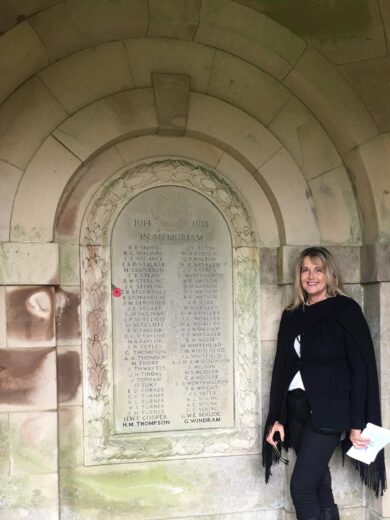
Karin Windram by her ancestor’s name on the Cloisters.
As Sedbergh prepared for Remembrance Sunday we were honoured to receive a rare visit from the Gallipoli Association who came to speak to Year 11 pupils about the WW1 Gallipoli campaign.
Mike, Sophie and Tom from the Gallipoli Association led a tailored and moving workshop. The team spoke about the Association’s work surveying the battlefield sites and providing educational trips for young people. Their discussion about underage soldiers during the campaign was particularly poignant. The Year 11’s were shocked to hear that the youngest allied casualty of the Gallipoli campaign was Desire Blanco, a 13 year old French solider. The youngest British military casualty was Private Richard Scott who died on 13
th June 1915 aged 15. He had claimed to be 17 when he enlisted.
The workshop was tailored to feature details of the 66 Sedberghians who served during the Gallipoli campaign, and the 27 who lost their lives, with information about the actions that Sedberghians were most closely involved with.
Mike gave a personal account of his great uncle, Private John Arthur Crane’s service and death during the campaign, and spoke about his personal pilgrimage trips to Gallipoli to honour and research Private Crane. As the workshop drew to a close Mike invited two pupils to participate in ‘blowing the whistle’, re-enacting a battlefield advance with an original artifact, a whistle that was used in 1915 during the campaign. After the formal end of the workshop pupils had the opportunity to view – and in some cases handle – guns, swords, munitions, medals and uniform used at Gallipoli. This final segment of the workshop was in keeping with the ethos of the whole event, structured to be engaging, shocking, surprising and deeply poignant. Staff and pupils were tremendously grateful to Mike, Sophie and Tom for the preparation, thought and great effort they had gone to in order to bring this special workshop to Sedbergh.Bob Peters, a former Sedbergh School scholar, has been a great supporter of the School. He kindly agreed to share his experiences at School and in business.
You were at Sedbergh 1984 – 89 in Lupton House. What was Sedbergh like in those days?
When you compare it to now it was a lot more spartan. If you were last back to the changing rooms after a rugby match you’d be getting into a bath that was brown, and full of mud, because ten other boys had gone in before you. It was tough environment, particularly to come in as a day boy as I did through the bursary system. I’d left my friends in Sedbergh town to become a ‘Sedbergh School boy’ so they felt I wasn’t one of them, but at the same time the Sedbergh School boys didn’t accept me straight away because I was a local. It was very personable, though – class sizes were very small. My history class had just five or six of us in the class. I have really happy memories of being here, and I got a lot out of it.
How did your Sedbergh education prepare you for later life?
It instilled the values which I hold today: kindness, a toughness, a humility, confidence, knowing right from wrong, and a discipline that has been really important throughout my life. It didn’t necessarily prepare boys for the career route I took but the values have been important to me.
You left School in 1989. What did you do after leaving School?
The first thing I did was head to the north of Cornwall with lots of Sedberghians. We spent two or three weeks there partying, having fun, and pretending to surf, and then I didn’t have any connection with Sedbergh for over 20 years.
I didn’t want at that time to be part of the ‘Old Boy’ network. For many years I didn’t want to have anything to do with Sedbergh and had a real chip on my shoulder about it. When people found out that I’d been to private school they thought I was a bit of ‘posh boy’ and that irked me, because I’m not a ‘posh boy’. I came to Sedbergh on a bursary and my mum, Val Varley, worked so hard to look after us. She was a cook in Winder for years, and a matron, and did every job going at School. The other boys I was at Sedbergh with would go off on exotic holidays in the summer, and my brother and I would spend the summer holiday cleaning toilets at Killington Services to save money for our family. At the end of the summer we’d go camping in the Channel Islands with mum – different from the holidays of the boys I was at school with, but they were the best holidays. People assume I had a silver spoon, but I’ve never been gifted anything, other than my bursary. I’ve always had a strong work ethic, ever since my mum and stepfather were running the Cross Keys at Cautley, and my brother and I were coming home from Sedbergh School in the evening as day boys and going straight out waiting on tables and washing up in the kitchen. I’ve worked very hard all of my life.
When I became successful with my travel business I felt it was time to re-engage. I’ve always had a connection with Sedbergh, my mum still lives here and so I’ve always visited, this is home for me. Coming back in my early 40s I started to catch up with the old Masters, and got involved with the OS Club and the School. I don’t have children and have to spend my money somehow, giving back to the Roger Lupton Scholarship and Bursaries Scheme really appealed to me. I was given a bursary and I’m really grateful for that. I wanted to use my money to do some good.
How did your early career experience lead you to the business you have today?
I spent 15 years working at TrailFinders essentially doing my ‘apprenticeship’, working with the first class and business class customers. My skill set lay very much in the luxury end of the market, working with people who spent anywhere between £5000 and £500,000 on their holidays. I was fortunate that when I set up my own company many of those clients moved with me so I had a ready-made portfolio of clients from day one. That was humbling. People invest in people and I felt honoured that the clients had enjoyed working with me, and were confident that I could provide that service when I set up business by myself.
I feel blessed that I have the perfect work-life balance, I love what I do. I love getting up in the morning and helping people book their holidays. My role at ‘Bob Peter’s Travel Counsellors’ has changed over the last few years, in that I built up a team of other travel counsellors who work with me, and they are the ones who now have direct contact with the clients and I’m now in a business development role bringing in new clients, getting referrals. As such, I’ve stepped back and let my team take the reins.
I now look after around 30 OS, facilitating their own travel arrangements. They love that they’re being looked after by an OS, and I love that I’ve reconnected with them and can give back by providing a service for them.
Why is Bob Peters’ Travel Counsellors unique?
Our clients trust us because we will go the extra mile to find the best solution and the best fares. If we spot that there’s a fare the day before that would save a client £500 then we’ll highlight that. We always look at the long game, if you look after clients and give them a good service then they’ll be loyal and they’ll tell their friends.
We work with celebrities planning their bespoke luxury holidays, but also with ordinary people organising a special holiday that fits their needs. I’ve never had a request that we haven’t been able to fulfil. Whatever a client wants from their holiday we find a way to provide it. Everything we do is personalised, we’re not restricted by only using partner hotels or airlines in the way that other travel companies are. We can book anything, anywhere, anytime.
One of the more unusual things I’ve done was during COVID-19. Two weeks into lockdown I had a call from a friend asking if I could support one of her friends with a travel issue. I was perplexed as no one was travelling anywhere at that point. The next thing I knew I was organising the travel for twenty rocket scientists from Space X who were at Lake Como in Italy and needed to get to Orlando. Over the next three years I did five rocket launches, transporting the scientists on a mixture of private jets and commercial flights, together with their accommodation and car hire to get everyone in the right place at the right time. My work is incredibly varied and unlikely but we’re willing to take on anything and always find solutions.
Looking back, bizarrely, COVID-19 was the best thing to have happened to my business. Martin Lewis from Money Saving Expert highlighted the company as the best in the country in terms of ensuring that all of our clients got all of their money back for COVID-hit holidays, and within a short timescale. We are ATOL protected, so none of our clients lost a penny. Our clients were raving about the service they’d received and that had a snowball effect. As the world opened up again, not only were we inundated with enquiries from people we’d worked with before who were re-booking, but those people had also generated a wave of new referrals, as they were telling all of their friends about the service they’d received.
Your company Bob Peters’ Travel Counsellors is a major sponsor of Sedbergh Alumni events. Why is it important to you to give back to Sedbergh?
My brother and I benefitted from the bursary system at Sedbergh, and ultimately, it’s the right thing to do to give back. Sedbergh is still home to me, and to be able to give back to my hometown is important, it draws me back.
Many of my contemporaries from Sedbergh are now parents of pupils here and it’s wonderful to reconnect with them and remain part of the community. By sponsoring events, such as those I’ve sponsored recently in both Sedbergh, and at Lord’s Cricket Ground on the 3rd October 2025, I’m helping keep that community going and that’s important to me.In November, the Sedbergh community gathered in Hong Kong for a fantastic evening – the first get-together in over two years, and one made all the more special as 2025 marks 500 years of Sedbergh’s excellence in education.
Around 40 people attended, including an impressive turnout of Old Sedberghians along with parents, friends, and even one OS who happened to be passing through the city. Set against the backdrop of Hong Kong’s iconic skyline, the event was a reminder of the strength of our global community.
Headmaster Dan Harrison gave an inspiring speech reflecting on the School’s recent milestones and sharing an exciting vision for the future. Development Director Ben Collins reconnected with OS spanning many generations, highlighting the bonds that Sedbergh fosters.
We are delighted to now be establishing a Hong Kong Sedbergh Association group, which will run its own events to build and deepen connections, friendships, and business networks among OS and families in the region.
A wonderful evening, and the start of a renewed chapter for Sedbergh in Hong Kong.‘I was saddened to see that Robert ‘Jock’ Pattman had passed away. There are some people you meet who you never forget and Jock was one of those. As a Scotland and Glasgow Rangers fan, he would have loved Scotland’s recent and spectacular qualification for the World Cup, but wouldn’t be so impressed with Rangers’ performances.
We were both in Winder House and on the School running team in the early 70s. Jock was a maverick but he was kind and we had some good fun. I want to pick out three instances:
In a closely fought race at Ampleforth in 1972, Jock won the race helping us win the match. He was very modest about it and more interested in the performance of others than bragging about his own performance.
In 1973 I was sent to the Sanatorium with a temperature of 105(!) and told I could not run in the Ten Mile, my only chance to run the race. Within 24 hours Jock was knocking at the Sanatorium window offering me an ‘escape route’. After a week I finally got out and Jock suggested we run the Ten Mile together to show I was fit to run the race. We had a great run round the course in 1 hour 17mins but breaking the rules didn’t impress the Housemaster!
My most lasting memory of Jock was the Blue Ribbon in the summer of 1973. Jock decided that three of us should run it including John Bullock who was a natural sportsman but not a recognised runner. Jock coaxed him round the Ten Mile, the Three Mile and most of the way up Winder in an excellent time before Bullock broke down. Jock was determined he should finish and they spent a long time arguing near the top of Winder as any chance of a good time slipped away. But Jock was like that. He cared more about others than himself, and added colour to our lives at Winder House in those days over 50 years ago now.
I haven’t seen Jock since Sedbergh but very much hope he had a good and enjoyable life’
We are pleased to announce that the November 2025 edition of Floreat Sedberghia has been published.
You can read an electronic copy of the newspaper below:
If you would like a hard copy please let us know and we will post one out to you.
Feel free to write to us and let us know your news – either email to osclub@sedberghschool.org or write to The Editor, The Development Office, Sedbergh School, Sedbergh, Cumbria, LA10 5HG.
We hope you enjoy reading it.