




Month: June 2023
Head of History 1984 – 2015
Sedbergh School is saddened to record the death of former teacher, Michael Raw, on 27th May. Educated at Haberdashers School and Queens College, Cambridge, Michael was invited to join the Common Room of Sedbergh School in 1984 as Head of the History Department.
Michael was a generous colleague and a compelling teacher. His propensity for clear, erudite explanations of the subject matter combined with entertaining and often gruesome detail created an enviable level of engagement with his pupils.
Unashamed of his eccentricities Michael chuckled at the reputation he enjoyed. Pupils recall the windows of Room 13 open all year round, in sun, wind and even the odd Cumbrian snow storm. Michael was a willing judge for any school competition from house drama to academic challenge. His cutting, occasionally brutal critique of pupils’ performance could certainly not be called pithy but was always entertaining, apt and often surprisingly edifying.
After writing in his early adulthood for amongst others the Cambridge footlights and ‘Not The Nine O’clock News’ Michael had to content himself with writing and performing in Sedbergh’s own sketch show ‘A kick in the stalls’ and its various sequels. One particularly memorable scene featured Michael in Y fronts grunting as a monosyllabic caveman. Shocking for pupils and colleagues alike this hilarious performance typified Michael in that it was funny, unashamed and perfectly pitched. When a spoof ‘Micky Raw Sedbergh’ twitter account emerged in 2012 readers were fairly sure that it was a parody – but with Michael anything was possible.
Michael was unashamed of his determination to do things the old way and found that his genuine charm and warmth meant others wanted to accommodate him. His reluctance to use a computer was warmly indulged by the school secretary who typed his hand written pupil reports for many years after the Common Room embraced a computerised report system.
Michael was a generous, entertaining and warm host who welcomed many colleagues and former pupils to his home. An evening at one of his successive Sedbergh residences was a richly sought after prize, particularly as it came with viewing rights to Michael’s extensive collection of historic artefacts, modern art and an enviable library. Conversation was lively as Michael brought together friends from different aspects of his life, regailing them with stories of his work on radio and television comedy, and name dropping with ease.
During a stint playing for the Harlequins Michael gained what he described as his ‘cauliflower ears’ as well as a keen sense of sportsmanship. At Sedbergh he coached the First XV from 1987-1991 and later moved to the B1 team with whom he stuck for much of his career.
Sedbergh has benefitted from Michael’s writing and attention to literary detail over many decades, first during his time as editor of the Sedberghian and latterly as Michael was appointed to chronicle various aspects of the school’s history. Prior to retiring from teaching Michael was invited to write ‘Thread of gold’, a history of Sedbergh School Football Club. He approached this with his trademark thoroughness reading every historic issue of the Sedberghian magazine, Captains’ minute book, Governors’ minute book and personal memoir available.
In recent years Michael undertook the substantial role of school historian, seeking to research and write a new history of the school in time for the 500th anniversary. Michael’s diligence and integrity made him the perfect person for this role. He sought to accurately represent the community he served while ensuring that the individuals involved were portrayed compassionately. Michael’s portrayal weaves the events of school life into the context of national and international history in a manner that elevates the book beyond the ambitions of many coffee table school histories. Michael died whilst writing the final chapter. The completist in him would have been slightly frustrated with the premature ending to his career as a writer but the comedian in him would have chuckled at the off beat timing.
Michael travelled to the Baltic states in mid May for a much anticipated holiday. Unsurprisingly he travelled with a suitcase full of history books about the region, keen as always to expand his knowledge and engage deeply with his subject matter. Michael died in his sleep on holiday.
Michael’s death is a great loss to his many friends in the Sedbergh community and further afield. He was a special man who will be sadly missed.
By Katy de la Riviere
Michael Raw was a deeply loved individual and has been a great influence over the lives of so many colleagues and Sedberghians. The OS Club has had an overwhelming response to his passing. We include one such tribute from Oliver Foster (W 97-04):
“MAFR was one of those truly remarkable people who seemed to be the very embodiment of Sedbergh. His razor sharp intellect, his dry wit and his undoubted ability to command the attention of pupils and staff both in and out of the classroom were just a few of his attributes.
Generations of Sedberghians will remember him for all manner of different reasons (Rugby, his love of fizzy blue bottles, Rm 13 with its windows open regardless of whether a new ice age had descended outside or not, his love of “notes”; a phrase which sent shivers down the spine of many!).
When all is said and done though, we who were fortunate enough to have known Mr Raw owe him a debt we will never be able to repay. Sedbergh has lost a “giant”, a man who’s like we will not see again and we are all the poorer for it. May you rest in peace, Sir!“
We have had many requests for further information, which fall into three broad categories. In response:
- For those who wish to write a letter of condolence, and given that Michael had no immediate relatives, we ask that you send your letter of condolence to: In memory of Michael Raw, Old Sedberghian Club, Sedbergh School, Sedbergh, Cumbria, LA10 5HG. These letters will then be used to make a memorial book. Please make sure you include your name, address and email.
- Many have asked if there will be a funeral or memorial service. Undoubtedly there will be, but the School is still coming to terms with Michael’s loss. We will update everyone once such decisions have been made.
- Some have asked if they can mark Michael’s passing by a donation. It has long been known that Michael was keen to raise funds for a Roger Lupton Scholarship through the proceeds of the book he was writing (The History of 500 years of Sedbergh), and had said as recently as two weeks ago that this was an important to him. After discussion with the Headmaster, and others, we ask that any donations are made to the Roger Lupton Scholarship Fund which you can find here.
Thank you to all those who have been in touch. He was indeed a very special and dearly loved individual.
Jan van der Velde
The Start Up Forum is an initiative which has its roots in a concept by Alex Hambley ,and has subsequently been developed by Andrew Stott such that, through Andrew’s endeavours and persistence, the Forum now numbers over 60 participants.
It is a place where the Sedbergh Community can celebrate and support entrepreneurship and is made up of investors, budding entrepreneurs, and those from a business or financial background.
Old Sedberghians, of all ages, have an opportunity to pitch their ideas to the group with a view to raising finance, and to receive mentoring or advice to help them grow.
On 24th May there was a gathering of the Forum at the London Steakhouse (a very fine establishment owned by James Robertson E 87-93). It was an opportunity for people to meet in person and therefore to overcome a downside of Teams meetings. Andrew Stott reminded us of the importance of entrepreneurship, and the value we can bring by supporting each other.
In developing his programme, he has asked for investors to put £5,000 into a central fund. This will be used to invest in new projects for which people will eventually receive a return if the projects are successful. In the fullness of time Andrew intends that some of this return will go towards Roger Lupton Scholarships. A worthy cause indeed, and part of a very joined up and imaginative initative to help future generations. Well done Andrew and thank you for a great evening.
If you would like to know more about the Start Up Forum please email Andrew Stott: support@osstartups.com
Jan van der Velde
Churchill spent a lot of time there, they have been visited by millions, they were once the nerve centre of our fight for freedom, and it was about time we paid them a visit. I am talking, of course, about the War Rooms and on 23rd May, 60 people from the Sedbergh Community gathered there for a celebratory 1525 lunch.

While it is usual for people to gather for a pre-lunch sip of bubbly, we had, on this occasion, the opportunity to explore what were once the corridors of power and see where the great man once made vital decisions in defence of this country. It was inspirational stuff and afterwards we sat down for a wonderfully prepared meal while hearing from the President, John Walford, the Headmaster, Dan Harrison, and a former Roger Lupton Scholar, James Horan.
John Walford made an interesting observation. People that leave a legacy, do so in the hope that it will allow those from a younger generation to achieve their full potential. In turn, those recipients will one day make a similar contribution to the School. In such a way the legacy lives on and is passed down from generation to generation.
This was echoed by James Horan who, a future trainee lawyer at a city firm, hopes to leave a legacy for those that follow in gratitude to Sedbergh. James spoke well, in a moving speech that reflected on where he would be now if it wasn’t for the opportunity that had been afforded him by the Sedbergh Community.
Dan stated that the School is showing an optimism not seen since the turn of the 20th century. Given that Sedbergh will have 600 in the senior school next term and 200 in the prep school, who can argue with him.
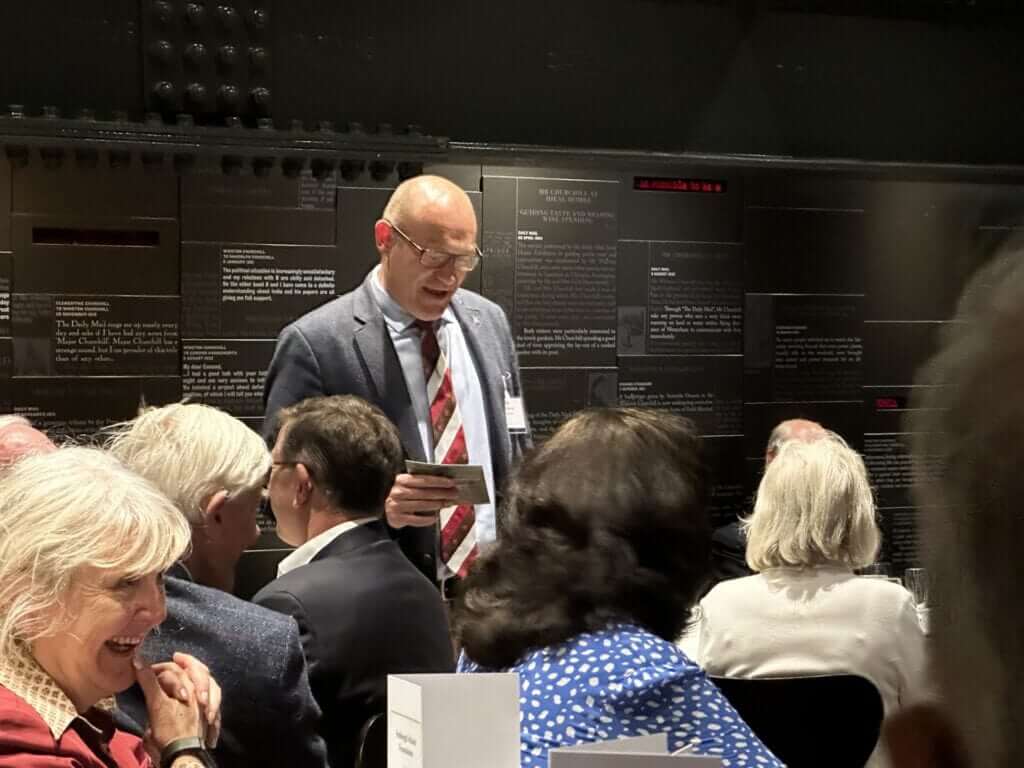
Lady Joyce Singleton-Booth stood up at the end to thank Sedbergh for a wonderful day. And it was a wonderful, if not remarkable, day, enjoyed by all, and in celebration of the generosity of the Sedbergh community.
Jan van der Velde
One of the joys of my role is to hear from people that I haven’t met before. There is an Irish saying, ‘a stranger is a friend you haven’t met yet’ and while I have come to know a great many people in the Sedbergh community over the last 45 years, there are still many whose acquaintance I am yet to make.
It was with delight therefore that we received a letter from James Walker (known as Jim), a fellow Luptonian who had been in Sedbergh from 1946 to 1949. Within the letter, Jim had also included a very generous donation to the Foundation. Being most grateful, and also intrigued, I arranged to meet him in his hometown of Tunbridge Wells.
All that running around the fells, and the cold baths, in post-war Britain had done him good. Jim, now 90, greeted me with a big smile, looking very sprightly, and with a sparkle in his eyes, that told me he was on top form and enjoying life. Everyone has a story to tell, and over coffee, he told me his.
There are three themes that run through his life. His Christian faith, his time as a surgeon, and his family.
Jim joined Lupton House in 1946. Mr Christofferson had just left, and Mr Collinson was in situ as Housemaster. Those days were strict. Shorts were worn even in winter, and hands in pockets weren’t allowed during your first term. Second term you were allowed one hand in one pocket and by the end of the year you were allowed to keep your hands warm if, that is, you hadn’t already succumbed to frostbite. ‘It was a hard school’, Jim reflected, ‘but if you were prepared to do your best, you were welcomed into the family of Lupton House’.
Of all the aspects of Sedbergh, it was the Headmaster, Mr Bruce-Lockhart, who had the greatest influence on him. Jim came from a devout Christian family in Ireland, and while Mr Bruce-Lockhart demanded respect and fear in equal measure (a fact that was persuasive upon Jim’s father in the choice of school), he was a deeply religious man. In 1947 when Jim was confirmed, he was told to visit the Headmaster one evening. Petrified, Jim was ushered into Mr Bruce-Lockhart’s room, where he was invited to sit in front of a warming coal fire.
‘It was like going home’, said Jim, ‘Mr Bruce-Lockhart wanted to know about my character and I have never forgotten our fireside chat’. Jim went on ‘Mr Bruce-Lockhart (I noted the respect even now for his old Headmaster by the continued use of his surname) didn’t want to be thought of as an extraordinary man, although he was, and tried to bring things down to your level. His sermons were at times deeply moving and I still remember his sermon about the bird’. Jim looked upwards as he recollected ‘I couldn’t hear the bird because I had shut the window. But it wasn’t the bird who was the fool, it was I’. Jim smiled as he could tell I was trying to make sense of what he had just said.
A large part of Jim’s life at Sedbergh was dominated by sport. ‘A keen rugby player, a good fullback and a strong kicker’ said Jim but with suitable modesty. Added to this was his love of tennis and shooting.
In 1949, however, while enjoying the full extent of activities that Sedbergh had to offer, life was to take a new direction. While in London with his parents that summer he started coughing up blood and was diagnosed with pulmonary TB. At the time treatment was in its infancy, but a new cure, streptomycin combined with para-aminosalicyclic acid, over a period of up to two years was thought to be a more effective way to treat the disease, than bed rest and surgery. Thus, Jim became one of the first in the UK to undergo this new regime of drugs.
‘For six months I wasn’t allowed out of bed and had daily injections which became sore after a time’ said Jim, but with typical Sedbergh stoicism. Eventually, and by degrees his health improved, and eventually he was allowed back to Ireland, transported by rail in a carriage completely to himself. While, sadly, he never returned to Sedbergh, the three years he had had in Lupton House, were formative, and he has never forgotten those happy times and the friends he made.
Jim went on to study medicine, inspired in part by his experience with TB, and also by his aunt who had been a missionary doctor in Africa. During this time he met Shirley, later to become his wife, and whose father was an Old Sedberghian. ‘We have now been married for 60 years’ said Jim with great pride and affection.
Encouraged to specialise, Jim trained to become a surgeon, and such were, and are, the demands of the discipline, and despite being in the top 10 of 120 in medical school, Jim admits it took him a while to pass the exams. But in 1964 he was finally elevated from Dr Walker to Mr Walker and having spent some time post qualification in Jamaica, in 1967 he, with his wife and three young children, took up a post in Rwanda with the Church Missionary society. ‘We had to learn the language when we got there’ said Jim, ‘but we were made most welcome, almost revered, because my aunt had also served there as a doctor and had been greatly mourned when she was killed in a car crash while travelling between Rwanda and Uganda some years earlier’.
Jim spent six years in Rwanda, alleviating people’s suffering, although he himself talks about it with great modesty. Smallpox, at the time, was still prevalent in Africa, a deadly disease now eradicated from the planet, and he was tasked with treating it as best he could. Indeed, while the UK had established the NHS in 1948, in Africa there was little access to modern medicine, or surgical skills. His work, I’m sure, would have been life changing for many. No wonder the name ‘Walker’ carried such currency in central Africa.
By 1973 however, and with the children becoming teenagers, it was time to return to the UK. For the last 15 years of his working life he headed up the A&E department at Tunbridge Wells which explains why, many years later we found ourselves there, talking about his life, while enjoying a coffee. He is a tremendously spirited man, gentile, happy, and deeply interesting. There is much to this man, and so much to tell, but that would need a book with many chapters.
We ended by my asking him what had persuaded him to donate to the School. ‘Because’ he said, while looking me in the eye, ‘I owe so much to Sedbergh. Those three years set me on a course in life such that I never looked back. I am indeed most grateful’.
We shook hands; it had been a great privilege to meet him and to hear his story. One of many thousands whose journey had started at Sedbergh, defined by a process which has become the happy parent of so many generations over a span of half a millennium. He may have come from a different era to me, and our backgrounds are quite dissimilar, but we are both Old Luptonians and Sedberghians, and by the end of the coffee, it felt like we were old friends. Thank you Jim, it was a great pleasure to meet.
Jan van der Velde
Chris played for the 1st XV during his time at Sedbergh School and captained them in the 2010-2011 season. Here Chris tells us about TI Rugby:
“I set up because after experiencing the academy route in sport from the age of 13 I realised there was a gap in the market to support young people trying to meet their potential. I took up coaching and coached multiple men’s and women’s teams during and after my time at Durham University. On leaving Durham I was approached for help by a female player trying to get into her national squad. Working with her made me realise there was huge inequality in the female game despite its growth.
TI Rugby was built to provide support, guidance and specific rugby strength and conditioning for all female rugby players at every level.
TI Rugby provides weekly online training plans that are specifically designed for rugby. It consists of four sessions designed to work alongside club training or be used as a stand-alone tool. We promise results with as little as two sessions a week. Accompanying every training plan is a link to video demonstrations by myself. Here, I talk through and demonstrate how to complete movements and offer information on rehab and prehab. We work with both Rugby League and Rugby Union athletes.
The difference between TI Rugby and other online training plans is:
1. We understand almost all female athletes/players have other demands on their time and therefore we make every session time-efficient and each session can be done within an hour and some as little as 40 minutes.
2. We provide a new program every week to keep it interesting and keep the player stimulated.
3. Video demonstrations are provided to break down every movement
4. Every player who signs up has direct access to contact me, where I can help them work around injuries or niggles, look at some of their specific goals or offer further holistic advice.
I have worked with a number of players so far both at the community club level as well as premiership and international players.”
If you would like to chat or discuss options with Chris you can contact him on chris@tirugby.com.
You can read more about it here https://tirugby.com/ and there is also an Instagram page just search for TI Rugby (https://www.instagram.com/tackleit_rugbycoach/).

“In June, I am embarking on a road trip with my friend Rafa to the Arctic Circle to compete in the Midnight Sun Marathon: 26 miles of racing the sun before it reaches the horizon.
We have chosen to fundraise for Alzheimer’s Research UK, a fantastic charity fighting against what the ONS has recently concluded as the leading cause of death in the UK.
All donations will support their efforts to understand causes, diagnose earlier and more accurately, spread awareness of risk factors, and discover more effective treatments.
As we come to the end of our 12th week of training, there remains a long road ahead (literally). This is our first marathon and any donations towards Alzheimer’s Research UK would be greatly appreciated. Stay tuned as we post updates about our journey and fundraising leading up to the race!”
You can donate via Fraser’s Justgiving page here.