We are extremely grateful to Peter Weeks (Powell 64-68) for his report regarding Robert Digby-Jones, who was awarded the VC after the Boer War. Peter recently visited the grave of Digby-Jones in South Africa. He writes:
We are all familiar with the monument above the Cloisters commemorating the 3 OS who won the VC in World War Two. Less well known is Sedbergh’s fourth and earlier VC, awarded posthumously for an action that took place in the Siege of Ladysmith during the Boer War. On a visit to Ladysmith a few years ago I found the grave of Robert James Thomas Digby-Jones. This is his story.
Robert Digby-Jones was born in Edinburgh in 1876 and educated at Alnouth, Northumberland and at Sedbergh. He entered the RMA Woolwich in 1894 and was commissioned 2 years later into the Royal Engineers. 1899 found him in 23 Field Coy, RE, in the small town of Ladysmith in Natal, South Africa at the start of the Boer War. The town was soon surrounded and besieged by a Boer army which overlooked the town from a ring of low flat-topped hills. Wagon Hill lies to the south just within the British lines. During the night of 5th January 1900 a party of gunners and sappers including Lieutenant Digby-Jones were installing a naval gun on the south-west point of Wagon Hill when out of the darkness Boers from the Free State made a surprise attack. Fierce fighting continued into the morning all along Wagon Hill – a critical point for the town’s defence – before dying away. Around one o’clock a party of Boers again stormed over the edge of the crest, this time reaching right up to the gun emplacement. Digby-Jones shot one of the Boer leaders, De Villiers, at close range with his revolver and led the fight to clear the hilltop, losing his life in the mêlée.
Digby-Jones lies in Ladysmith cemetery. Near the site of the gun emplacement on Wagon Hill are memorials to him and to De Villiers.
An interesting footnote. The award of posthumous VCs was sanctioned by King Edward VII in 1902 after the end of the Boer War with the family of Digby-Jones receiving his medal. Formerly the VC was only awarded to living recipients.
Brass tablets were put up in St Mary’s Cathedral and Alnouth parish church to his memory and a red sandstone memorial stands in the grounds of the School Chapel behind Malim Lodge.
Peter Weeks
OS, P (1964 – 1968)I’m not sure if you have ever had the chance to visit the New Club on Princes Street, how would I know after all. On the assumption that you haven’t been there, let me tell you that the Club is not new, neither is it easy to locate.
If you are lucky enough to be invited you will find it on Princes Street in Edinburgh behind the most unassuming of grey doors which normally would be taken for an entrance to an NCP car park or the type of door on the Underground that has ‘Authorised Personnel Only’ written on it. Many times have we received desperate last minute phone calls over the years asking where the New Club is by those in need of a prosecco.
And so this November we once again hosted the Edinburgh Lunch for forty of the finest people you can find in that glorious city. What I really enjoyed, and there was much to commend, was the mix of ages. We need youth as well as experience, and we had both. On a personal level I was delighted to meet people whom I haven’t seen since my school days. The warmth of human fellowship was abundant, and the general crescendo of chatter in the dining room filled our ears, telling Ben Collins and I that such events are so worthwhile to hold, and to attend.
The Headmaster, Dan Harrison, spoke about the success of the School and his optimism for the future. He was animated, his banners unfurled, his colours nailed to the mast, and whatever other idiom one might care to use to express the Shakespearean ‘Henry V at Agincourt’ that stood before us. It went down very well.
Our thanks to the New Club and in particular to Neil McKerrow for acting as our host member. And thank you to all those who joined us. We did
very much enjoy your company.
Jan van der Velde
Lupton House 1977-1982
Director of DevelopmentMembers of our Community may have seen the news that a major fire has damaged the centre of Kirkby Lonsdale. Tragically one man died in the blaze. We offer our sincere condolences to the family.
The fire could not have come at a worse time for traders in this historic market town. Our thoughts are with those who have been affected.
Here is the Fundraiser page for those who may wish to offer support.
I would like to highlight one in our community, an Old Sedberghian Josh Redmayne (H) who left School in 2017 to study jewellery in Birmingham’s Jewellery Quarter. In March 2024 Josh opened the doors of J.T.R. Jewellery in Kirkby Lonsdale. Now, after a successful launch and a good summer, his busy Christmas period had ground to an abrupt halt as the High Street closed whilst emergency services dealt with the situation.
He is a young entrepreneur, just setting out on his commercial journey. He will be helping out where he can in the town and, for the foreseeable future, will be donating 10% of sales for all nature pieces and bestsellers to help support those affected.
He hasn’t asked us to promote his business, as he is concerned more about the town than himself, but I know some may want to know more, and you can find the link to his business at
www.jtrjewellery.co.uk or his Instagram page
@j.t.r.jewellery.
Please note that there is also a Late Night Shopping event at junction 36 (Crooklands) on Wednesday 18
th December to support all the businesses in Kirkby Lonsdale.
As I say, our thoughts are with those in Kirkby Lonsdale. We wish them well and hope that the scars heal soon.
Jan van der VeldeSir Alastair Cook feels Harry Brook can challenge Joe Root’s England records; Brook has seven tons in 22 Tests and averages over 60, with Sky Sports’ Ian Ward saying: “His ability is staggering and it is the manner with which he can put pressure back on bowlers and go through the gears”.
Read full article
HERE.Renovations are always an exciting prospect in the world of conservation. Peeling off layers of paint, or plasterboard, dismantling furniture or taking apart artefacts can lead to a greater understanding of an item’s provenance or history. The process of uncovering untold stories can be a rich and enlightening experience.
This summer experts from Cumbria Stained Glass, Peter and Charlotte, spent several months working methodically to renovate the 19
th century windows on the School Library. The hand-blown panes are held in place by bands of lead in a 3 x 5 quarries pattern, apart from one rogue 3 x 4 panel in the southeastern most window. These panels are held in place in softwood frames that have suffered from the prevailing south westerly winds. Any conservation work on these iconic windows needed to be sympathetic to the original Grade II listed building with new elements matching the originals as closely as possible.
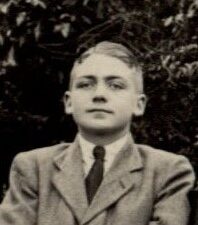
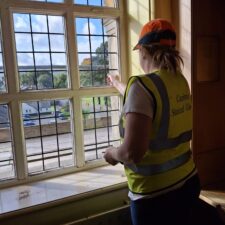
A joinery created new sections of frame to replace damaged originals. Peter and Charlotte painstakingly cleaned every pane of glass, carefully teasing out those panes that were being replaced, or migrated to new and sturdier frames. While cleaning a tiny pane of glass on the top floor, Charlotte was delighted to find a date and initials scored into the glass by a young graffiti artist. When looking through a tiny pane against the afternoon sunlight she spotted ‘AL 1922’ in the top corner of the glass. Having checked in the School archive it was found that there was only one boy in School with those initials in 1922.
-
-
Alec Laurie
-
-
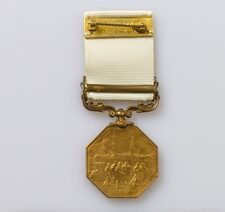
Polar Medal
-
-
Charlotte from Cumbria Stained Glass
Alec Hibburd Laurie, who hailed from Edinburgh, was a pupil in Evans House from 1920 to 1925. Despite his penchant for graffiti, he was a house prefect in his final year at School. He was the Bernard Wilson Scholarship recipient throughout his time at Sedbergh, so it is fitting that his chosen location for graffiti is now used as the scholars’ room in the top floor of the library. Academic endeavour was clearly important to him as he went on to study at King’s College, Cambridge before becoming Assistant Biology Master at Westminster School. His teaching career was fairly short as Alec soon joined the crew of the R. R. S. Discovery serving as a biologist and chemist. He served at the Discovery Investigations marine laboratory, South Georgia, in the 1930’s and on a whale marking cruise. He was well regarded in the field of marine biology for his research into reproduction of blue whales, and the physiology and structure of whale respiratory mechanisms. He was awarded the Polar Medal in 1941. During the Second World War he worked for Naval Intelligence and was involved in researching weapons. On returning to civilian life after the war Alec applied his scientific methodology to finding practical solutions for real world marine issues, such as harbour protection, fish farming and sewage treatment. He died in 1987 having made a tremendous contribution to the study of marine chemical and biology.
While we won’t be encouraging pupils who currently occupy the scholars booths to graffiti the windows, we’re delighted to have the example of Alec to share with them. A young man who clearly left his mark on the world, in more ways than one.
Katy de la
Rivière
Archivist