




Author: dean
4th Battalion 3rd New Zealand Rifle Brigade
Sedgwick 1895 – 1898
The School Archivist, Katy de la Rivière, was contacted earlier this month by the grandson of Rifleman George Windram. While researching George’s life his grandson had come across the Sedbergh School roll of honour online and was concerned to see that George did not feature in the document. George’s death was not recorded in contemporary Sedberghian magazines and sadly, the school had no knowledge of the sacrifice he made during WW1.
George Windram lived in Cheshire during his childhood and attended Birkenhead School before arriving at Sedbergh in 1895. George threw himself into Sedbergh life representing Sedgwick House in the Gymnasium House Eight competition and playing house cricket. He featured in an invitational rugby team formed by former pupil D. Rowley in 1899 and served the team well. The Sedberghian recorded that ‘Windram saved well’ and that ‘from the kick off the Browns pressed, and Bleased dribbled well until Windram come to the rescue.’ He remained a loyal friend to Sedbergh after finishing his education. In 1904 when a collection was made for ‘The Great Hall’, later named Powell Hall, both George and his father of the same name gave £1 1s each to the subscription fund.
After leaving school George held a commission in the British Army for a short time with the Scottish Battalion of the King’s Liverpool Regiment. As a civilian he embarked on a trip around the globe taking in South America, South Africa, Australia and New Zealand. He settled in New Zealand and purchased a sheep and beef farm near Whangarei in the northern part of the North Island. While resident in New Zealand George enlisted to fight in the First World War. George joined the 4th Battalion 3rd New Zealand Rifle Brigade towards the end of the war. On 31st December 1917 he set sail from Wellington on the vessel ‘Athenic’ bound for Glasgow, and then on to the front. Little is known of his military career but his death is recorded by the Commonwealth War Grave Commission as 12th September 1918, tantalizingly close to the cessation of fighting. George was killed by a sniper. He left behind a wife and young son in Onerahi, Whangarei, Auckland, New Zealand.
He is buried at Metz-En-Couture communal cemetery British Extension in France. Plot III D. 3.
During the 100 year commemorations of WW1 the Old Sedberghian Club sought to visit the grave of every known Sedberghian casualty. As news of George’s involvement in, and subsequent death during WW1 has only just recently reached the School, George was not included in the Old Sedberghian Club ‘Pilgrimage’. If any OS find that they are visiting the area near Metz-En-Couture and would be willing to visit George’s grave the OS Club would be delighted to send a pilgrimage pack with a Sedbergh cross to lay on the grave and the pilgrimage prayer to be read by the graveside.
Katy de la Riviere
A Bump in the Road chronicles the remarkable journey of an England rugby player as she battles back to the professional game just 17 weeks after the birth of her baby in July 2023 – and then to secure her place back in England’s Six Nations squad for 2024.
Adding an extra layer of intrigue, the ultimate decision-maker for her return to play at Bristol Bears is the women’s head coach, Dave Ward . . . who is also Abbie’s husband.
The beautiful film showcases the remarkable spirit of a mother driven by an extraordinary dream: to inspire her daughter and leave an enduring legacy in sport. The film also tackles long-held myths that prevent many women from remaining active during and after their pregnancies.
This visually stunning documentary, directed and produced by Sue Anstiss and Jack Tompkins, is incredibly timely, with the Women’s Six Nations Championship taking place this month and the Rugby World Cup coming to England in 2025.
Abbie is the first player to benefit from a new RFU maternity policy, as the media spotlights the challenges and triumphs of elite sportswomen returning to professional sport as mothers.
Read more and watch the trailer HERE.
As Sedbergh School prepares to mark its illustrious 500-year history, it is with great excitement that we announce the launch of our Quincentenary Events, a year-long celebration of academic excellence, community spirit, and enduring values.
Throughout 2025, Sedbergh will play host to a series of captivating events designed to honour our shared legacy and bring together generations of Sedberghians. Each event will serve as a testament to the strength and resilience of the Sedbergh community.
The festivities will kick off with a grand concert at the prestigious Bridgewater Hall in Manchester, setting the tone for a year of jubilation and reflection. Tickets for this unforgettable evening are now available for purchase via the Bridgewater Hall website: https://www.bridgewater-hall.co.uk/sedbergh-school-bridgewater-hall-concert/
“We are thrilled to embark on this journey of celebration and remembrance as we commemorate 500 years of Sedbergh School,” said Dan Harrison, Headmaster of Sedbergh School. “The Quincentenary Events are a testament to the enduring legacy of our institution and the remarkable individuals who have passed through our doors. We look forward to welcoming the entire Sedbergh community as we honour our past, celebrate our present, and embrace our future.”
You will find a list of the Old Sedberghian Golfing Society fixtures for 2024 below:
If you are interested in taking part please contact Alastair Smith on alastair.smith@frostrow.com.
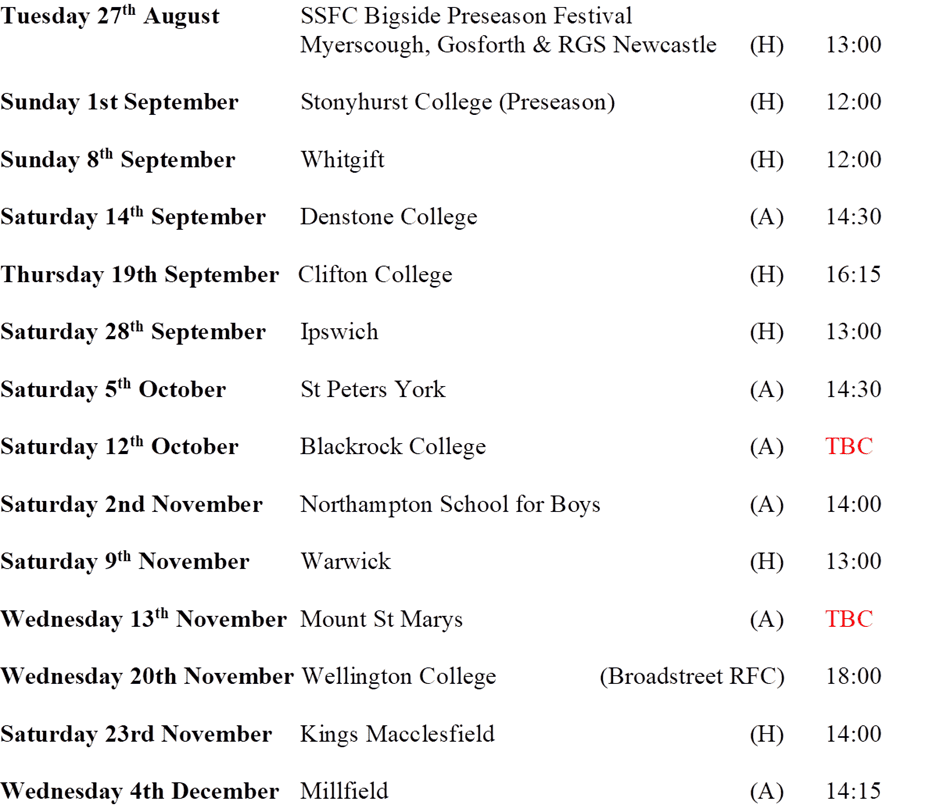
| Time/Date | Venue | Opponent |
| 11:00 Sun 14 Apr 24 | Home | Main School | Merchiston Castle School |
| 14:00 Wed 17 Apr 24 | Home | Main School | Myerscough OT |
| 14:00 Thu 18 Apr 24 | Home | Main School | Myerscough College |
| 11:00 Sat 20 Apr 24 | Away | QEGS Wakefield |
| 11:30 Thu 25 Apr 24 | Home | Main School | Marylebone Cricket Club (MCC) |
| 17:00 Fri 26 Apr 24 | Home | Main School | Cumbria U18 |
| 11:30 Sat 27 Apr 24 | Home | St Peter’s School, York |
| 11:00 Sat 04 May 24 | Away | Durham School Playground | Durham Cathedral Schools Foundation |
| 11:00 Wed 08 May 24 | Home | Main School | Shrewsbury School |
| 17:00 Fri 10 May 24 | Home | Main School | Cumbria Academy |
| 13:00 Sat 11 May 24 | Away | St Peter’s School, York |
| 11:30 Sat 18 May 24 | Away | The Oval | Stonyhurst |
| 11:00 Sat 08 Jun 24 | Home | Lancaster Royal Grammar School |
| 11:00 Sat 15 Jun 24 | Away | The Manchester Grammar School |
| 11:00 Tue 18 Jun 24 | Home | Main School | ARCA Cape Town |
| 11:00 Wed 19 Jun 24 | Home | Myerscough OT |
| 11:00 Fri 21 Jun 24 | Home | Main School | Yorkshire U16’s |
| 11:00 Tue 25 Jun 24 | Home | Main School | Durham Academy |
| 11:00 Wed 26 Jun 24 | Home | Main School | Lancashire Academy |
| 11:00 Thu 27 Jun 24 | Away | Main School | Scarborough College |
| 11:00 Fri 28 Jun 24 | Away | Main School | Scarborough College |
| 11:00 Mon 01 Jul 24 | Home | Main School | Brighton College |
| 11:00 Tue 02 Jul 24 | Home | Main School | Oakham School |
| 10:30 Wed 03 Jul 24 | Home | Main School | Wellington College |
I have now been in my new role as Director of Development for just over a year. I have the great privilege of working with some wonderful people; Ben Collins, Helen Seabridge, Maria Gallego-Calderon, Katy de la Riviere (outside of her Archivist role), Emily Rowe Rawlence, and David Calvert. Together we make up the Development Team.
Our remit is broad and you may not realise all that goes on in the Old Squash Court that is now home to our happy band.
We organise events, that much is pretty clear. Nowadays most events are sell outs, and combined with the increase in the number of functions this year, we have entertained and engaged with double the number of people that we did the previous year.
Not everyone is able to travel to events. We therefore go out to visit those who, because of infirmity or otherwise, cannot join us. It is important to us that such people are not forgotten or are left isolated.
We continually search for ‘lost’ OS. Our new recruit, Emily Rowe Rawlence, is tasked with finding lost souls. So far, since January, she has found 300 or so Old Sedberghians.
We have also reached out to Old Casteronians. Many of us remember our friendships with Castertonians or had sisters there. We are trying to help them reform their own association because we know their heritage and friendships are as important to them as they are to us. So far 250 Old Castertonians have signed up to this phoenix association.
Friendships aside, we aim to help the young. We now have a program in place where we invite people to share their career experiences with pupils. This is either through a formally recorded interview or in person. We are building up a bank of insights which dovetails with ‘Sedbergh Connect’, an online portal hosted by the OS Club to put Sedberghians and Old Sedberghians in touch with those who can assist with their careers.
An essential part of helping the young is raising funds for Roger Lupton Scholarships. Such scholarships are 100% funded by the Sedbergh Community. Presently we have 12 full time scholars, 12 individuals from disadvantaged backgrounds whose lives have been changed by the generosity of our readers.
Raising funds is not limited to Scholarships. The campaign to raise funds for the Tech Centre has been a success. The Appeal isn’t closed yet but the response has been overwhelming. Around the School we also support smaller projects, such that the pupils can enjoy the benefits of modern teaching aids and equipment.
Ben and I, as Old Sedberghians, remember our time at Sedbergh with great fondness. We believe in the School and therefore we facilitate the decision process that OS go through when they are considering Sedbergh as an option for their children by entertaining their families for a weekend.
In fact, there is so much that happens in our office that I can only touch on a few things here. The reason for doing so is this; after my first year to say thank you to my team, thank you for all your support, hard work, loyalty, and devotion to duty. I am grateful for all that you do. The Sedbergh Community is most fortunate to have you.
Jan van der Velde
Director of Development
It was while on my travels visiting Old Sedberghians around York that I found myself at the house of fellow Old Luptonian Peter Addyman. I was at School with his son, but I was meeting Peter for the first time.
What I like about such visits is that I never know quite what to expect. Except that, in my experience, every Sedberghian has a story to tell, and every story is interesting. I was certainly not disappointed and ended up staying far longer than expected as he told me how his time at Sedbergh led to the founding of one of the most successful and influential museums in the world, that of the Jorvik Viking Museum.
In a few words I will try to tell the story and do justice to this remarkable man.
Peter entered Lupton house in 1953. He made the mistake (his words) of mentioning he was keen on archaeology for which he got quite a ribbing. However, once the other boys in the junior dayroom realised he was serious they mentioned that there was a chap in the senior dayroom who was also interested in this field. Thus, he was introduced to Gavin Simpson (L51-55) and their archaeological partnership began.
It wasn’t long before Gavin discovered what he thought to be a Roman settlement at Underbank Farm, just outside of Sedbergh to the north of the Kirkby Stephen road. Peter disagreed, thinking it to be mediaeval. They therefore approached the farmer and asked if they could undertake an archaeological dig.
What is fascinating about this story is that they didn’t receive any outside help and they didn’t ask permission from their housemaster, so the whole dig, lasting months, was conducted in their spare time unbeknown to anyone at the School, and using a chicken shed as their field office.
It was an incredible undertaking and professionally recorded, as evidenced by the write up years later in the Yorkshire Archaeological Journal. And Peter was right, it was mediaeval.
At the time, news of the dig found its way into a local journal, The Dalesman, and soon afterwards Peter was summoned from his Latin lesson to the Headmaster’s Office whereupon he found Michael Thornely talking to two distinguished gentlemen. John Hirst, an inspector for the Ministry of Works and Prof Beresford, who later wrote ‘The Lost Villages of England’ had heard of the dig and wanted to see it. Michael Thornely, recognising that something quite special was happening, asked if he could come along.
So Peter and Gavin took them down to Underbank Farm. Peter crawled into the chicken coop as the hens scattered to retrieve the site plans from their ‘office’. The inspectors were suitably impressed and told them to carry on the good work. It was the seal of approval they needed, and they never looked back.
Both Peter and Gavin went on to study archaeology at university with Peter being awarded an archaeological scholarship to Peterhouse at Cambridge. Both later became professors in this discipline.
It was some years later that Peter was approached by York City Council to head up an archaeological team. At the time there was great concern that archaeological sites were being lost through redevelopment without being properly recorded.
One of the plans was to redevelop the centre of York City on the site of an old sugar mill. As it happened Barclays Bank, which lay adjacent to the site, had previously asked Peter to advise them when they extended an underground vault. It was during this work that Peter discovered something invaluable. Fifteen or so feet down lay the preserved remains of Viking York.
He therefore asked York City Council to demolish the mill three years early such that a proper archaeological dig could be undertaken. They agreed. Soon Peter’s team were unearthing Viking artefacts which have been preserved in the anaerobic mud.
It was one thing finding these artefacts, but they had to be preserved. Peter therefore set about creating a preservation laboratory which is now recognised as one of the best in the country, on a par with that of the British Museum.
All this cost money and during the dig, which lasted several years, a fundraising campaign was established. It was through this exposure that Peter received a call from an entrepreneur in Cumbria who had 70 car showrooms. This entrepreneur helped Peter monetise the dig by charging people to view the site. However, this was only a temporary solution, and the question remained what would happen to the site once the dig was complete. It was felt that it was too important to simply destroy.
This is where Peter’s genius came to the fore. He had the idea of recreating the streets using the original artefacts which had been preserved. The entrepreneur, through his connections, designed small cars for people to sit in such that they would be shown around the streets making it easier to bring people’s attention to where it needed to go. These cars would later do 75,000 miles each before they were retired.
Peter wanted visitors to have an immersive experience. They recreated the street sounds which were played through speakers. He invited a top perfumier from Liverpool to recreate the smells of rotting vegetables and excrement. The perfumier did say that this was a most unusual assignment.
The redevelopment of the city was therefore built over the museum and the site itself was preserved. The immersive experience, the unique method of being shown around, and the fact that it was in situ, brought the museum vibrancy and authenticity which was world-class. It set a new standard and the format has since been copied all over the world.
The museum opened in 1984. I was there, I visited it with my mother when I was home from university. It is still a fond memory, something that my mother and I spoke about often when she was still alive. We are two of the 25 million people who have now visited the Jorvik Viking Museum over its 40-year history. It is an astonishing place, conceived by an astonishing man, and its legacy is felt throughout the world.
Peter, it was a great privilege to meet you, to meet the person who has brought so much joy and understanding to so many people over the years, while preserving our history and our heritage.
Jan van der Velde
It was a great pleasure to meet up with Old Sedberghian leavers from 1980 and 1981 at the London Steakhouse on 9th February. As with every cohort of Sedberghians, life has taken these men in many different directions after leaving school, but the years melted away and the old stories of our time at Sedbergh soon started to be retold. As with all these stories they are probably nothing like the truth, having been embellished over the years (certainly mine are!) but they are all the more entertaining for it.
Although, as a 1982 leaver and therefore a junior, I was somewhat daunted to sit amongst these people I once looked up to (I still do of course); they welcomed me into their fold. For five hours the room was filled with conversation, laughter, and shouts of ‘please pass the wine’. It was a grand day and much fun.
Thank you to Bob (Rob Varley) Peters, from Travel Counsellors who kindly sponsored the event, and to James Robertson (E 87-93) at the London Steakhouse who gave us the familiar warm welcome that is always extended to visiting OS.
Throughout 2024 we will be hosting reunions for many year groups to celebrate all things Sedbergh. We look forward to meeting many more OS at these intimate events.
Jan van der Velde
As our global community grows it has been heartening to see how the values and traditions of Sedbergh School have been embraced by the new Sedbergh institutions across the world.
Since news last autumn of the collaboration between EQuest Education Group, Vietnam and Sedbergh School International Limited we have been delighted to welcome many of the senior staff from Sedbergh School Vietnam to Sedbergh to share the ethos that makes our community and our educational approach so special.
Jo Evans, the newly appointed Headteacher of Sedbergh School Ho Chi Minh City, has visited the school frequently through the spring, meeting with staff from across the school to inform her approach developing the new school in Vietnam. As part of her induction to all things Sedbergh, Jo has been involved in many of the milestone events throughout the term, including the Wilson Run. Development Office staff have been delighted to meet with Jo on several of her visits, to discuss the importance of alumni engagement, showcase highlights from the archive collection, and to outline the very important role that philanthropy has played creating the beautiful and well-resourced school that our pupils enjoy.
As term came to a close, we were delighted to host Jannie Hoang Anh Nguyen, Managing Director of Sedbergh Vietnam and Hong Thi Nguyen, Academic Operations Manager of Sedbergh Vietnam. Jannie and Hong undertook a ‘deep dive’ into Sedbergh culture during the final week of term, witnessing the Wilson Run, meeting with key staff and kindly dropping in to the department to spend some time with the Development Office team. Jannie and Hong were thoughtful in their approach to the visit, asking pertinent questions and exploring in detail what makes Sedbergh so special. We were delighted to welcome them to the Old Sedberghian community and give them each an OS scarf as a memento of their visit. Jannie also took a replica of the Casterton School uniform from the 1820’s as inspiration for the new kindergarten uniform. We look forward to collaborating with our Vietnam colleagues as they move forward with this exciting venture.