




Graffiti of Polar Explorer Found During Sedbergh School Library Renovation
Renovations are always an exciting prospect in the world of conservation. Peeling off layers of paint, or plasterboard, dismantling furniture or taking apart artefacts can lead to a greater understanding of an item’s provenance or history. The process of uncovering untold stories can be a rich and enlightening experience.
This summer experts from Cumbria Stained Glass, Peter and Charlotte, spent several months working methodically to renovate the 19th century windows on the School Library. The hand-blown panes are held in place by bands of lead in a 3 x 5 quarries pattern, apart from one rogue 3 x 4 panel in the southeastern most window. These panels are held in place in softwood frames that have suffered from the prevailing south westerly winds. Any conservation work on these iconic windows needed to be sympathetic to the original Grade II listed building with new elements matching the originals as closely as possible.
A joinery created new sections of frame to replace damaged originals. Peter and Charlotte painstakingly cleaned every pane of glass, carefully teasing out those panes that were being replaced, or migrated to new and sturdier frames. While cleaning a tiny pane of glass on the top floor, Charlotte was delighted to find a date and initials scored into the glass by a young graffiti artist. When looking through a tiny pane against the afternoon sunlight she spotted ‘AL 1922’ in the top corner of the glass. Having checked in the School archive it was found that there was only one boy in School with those initials in 1922.
-
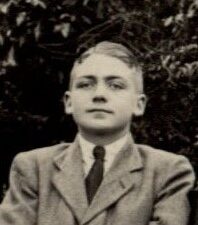
- Alec Laurie
-
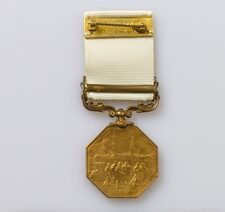
- Polar Medal
-
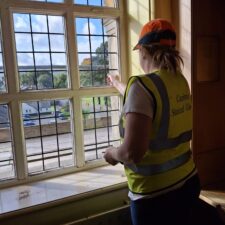
- Charlotte from Cumbria Stained Glass
Alec Hibburd Laurie, who hailed from Edinburgh, was a pupil in Evans House from 1920 to 1925. Despite his penchant for graffiti, he was a house prefect in his final year at School. He was the Bernard Wilson Scholarship recipient throughout his time at Sedbergh, so it is fitting that his chosen location for graffiti is now used as the scholars’ room in the top floor of the library. Academic endeavour was clearly important to him as he went on to study at King’s College, Cambridge before becoming Assistant Biology Master at Westminster School. His teaching career was fairly short as Alec soon joined the crew of the R. R. S. Discovery serving as a biologist and chemist. He served at the Discovery Investigations marine laboratory, South Georgia, in the 1930’s and on a whale marking cruise. He was well regarded in the field of marine biology for his research into reproduction of blue whales, and the physiology and structure of whale respiratory mechanisms. He was awarded the Polar Medal in 1941. During the Second World War he worked for Naval Intelligence and was involved in researching weapons. On returning to civilian life after the war Alec applied his scientific methodology to finding practical solutions for real world marine issues, such as harbour protection, fish farming and sewage treatment. He died in 1987 having made a tremendous contribution to the study of marine chemical and biology.
While we won’t be encouraging pupils who currently occupy the scholars booths to graffiti the windows, we’re delighted to have the example of Alec to share with them. A young man who clearly left his mark on the world, in more ways than one.
Katy de la Rivière
Archivist